Back to blog
Paid Marketing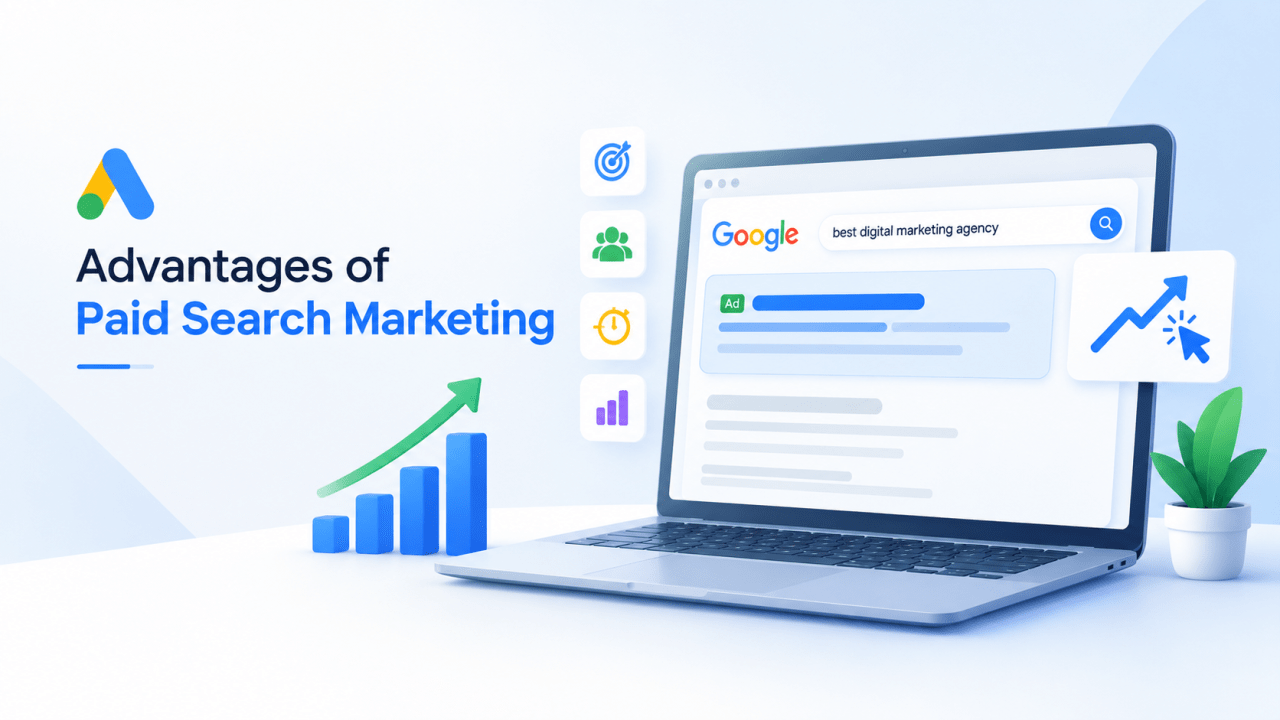
What Are the Advantages of Paid Search Marketing?
IIkshita Oct 30, 2026 6 min read

When people search online for a product or service, businesses have an opportunity to reach them at the moment they are looking for a solution. But appearing prominently in search results organically can take time and consistent effort.
This is where paid search marketing becomes valuable.
Paid search marketing allows businesses to display advertisements on search engine results pages (SERPs) for relevant searches. Platforms such as Google Ads help businesses connect with potential customers, drive qualified website traffic, and generate leads or sales through targeted advertising campaigns.
But what makes paid search advertising an effective digital marketing strategy? Let's explore its major advantages and how businesses can use it to achieve their marketing goals.
Paid search marketing is a form of online advertising in which businesses pay to display ads on search engines such as Google and Bing. These ads typically appear alongside organic search results when users search for relevant products, services, or information.
Most search campaigns use a pay-per-click (PPC) model, meaning advertisers generally pay when someone clicks their ad.
By targeting relevant search keywords, businesses can reach users who are actively looking for solutions, making paid search an important channel for lead generation, website traffic, and online sales.
Unlike SEO, which generally takes time to build organic visibility, paid search ads can begin appearing shortly after a campaign launches and becomes eligible to serve.
This helps new businesses, product launches, and established companies promote their offerings without waiting for organic rankings to improve.
However, ad placement depends on factors such as competition, bids, relevance, and campaign quality.
One of the biggest benefits of search engine advertising is the ability to connect with people based on what they are searching for.
For example, someone searching for "hire a Google Ads agency" may be closer to choosing a service provider than someone browsing general digital marketing tips.
Targeting relevant keywords allows businesses to focus on potential customers whose searches indicate an interest in their products or services.
Paid search campaigns offer control over advertising budgets and bidding strategies. Businesses can set budget limits, adjust spending, and allocate more resources to campaigns that meet their objectives.
This makes PPC advertising accessible to businesses of different sizes.
However, a smaller budget does not guarantee affordable leads. Costs depend on competition, keyword selection, conversion rates, and other campaign factors.
Paid search provides detailed performance data that helps marketers understand how campaigns are performing.
Common metrics include:
Impressions and clicks
Click-through rate (CTR)
Cost per click (CPC)
Conversion rate
Cost per acquisition (CPA)
Return on ad spend (ROAS)
With accurate conversion tracking, businesses can evaluate which keywords, ads, and landing pages generate valuable actions and make data-driven optimization decisions.
Paid search can support lead generation and sales by directing relevant users to focused landing pages.
Businesses can use search campaigns to encourage enquiries, phone calls, demo bookings, purchases, or quote requests.
The quality of the results depends on more than traffic alone. Relevant keywords, persuasive ad copy, a useful landing page, and a smooth conversion process all influence campaign performance.
Paid search advertising offers multiple targeting and optimization options, including keywords, geographic locations, languages, devices, and ad schedules.
For example, a local service provider can focus its campaigns on customers in its service area instead of advertising across an entire country.
Using negative keywords can also help exclude irrelevant searches and reduce wasted ad spend.
Paid search campaigns provide feedback that marketers can use to test different headlines, descriptions, keywords, bidding strategies, and landing pages.
This helps businesses identify opportunities to improve click-through rates, conversion rates, and acquisition costs.
Regular monitoring is important because campaign performance can change with competition, customer demand, and budget adjustments.
Paid search and SEO serve different but complementary purposes.
SEO focuses on improving organic search visibility over time, while paid search can provide visibility through advertising when campaigns are eligible to appear.
Businesses can use both channels to strengthen their search presence, learn more about customer search behavior, and support different stages of the buying journey.
Combining paid and organic search can create a more balanced digital marketing strategy rather than relying entirely on one traffic source.
Paid search can be particularly useful for businesses that want to generate enquiries, promote specific services, reach customers actively searching for solutions, or test demand for an offering.
However, it is not automatically profitable. Highly competitive keywords, poor landing pages, irrelevant clicks, and inaccurate conversion tracking can waste advertising budgets.
Before launching a campaign, define your objectives, research keywords, establish a realistic budget, and ensure you can measure meaningful business outcomes.
Running paid search campaigns successfully requires more than launching ads. Businesses need the right keyword strategy, relevant ad messaging, effective landing pages, and ongoing performance analysis.
RevX Media helps businesses strengthen their digital presence through Google Ads, SEO, and performance-driven digital marketing strategies. Our approach focuses on connecting advertising activity with measurable business objectives.
Explore our digital marketing services to find the right strategy for your business.
The main advantages include faster search visibility, high-intent audience targeting, flexible budgets, measurable performance, lead generation, and opportunities for continuous campaign optimization.
Advertisers create campaigns targeting relevant search queries. When a user searches for a matching term, an eligible ad may appear in the search results. Under the PPC model, advertisers generally pay when someone clicks the ad.
Neither is universally better. Paid search can provide faster visibility, while SEO can build organic visibility over time. The right approach depends on your objectives, budget, competition, and timeline.
Yes. Small businesses can set budgets and target specific locations or relevant keywords. Results still depend on competition, campaign quality, conversion tracking, and the value of each lead or sale.
Businesses can monitor conversions, cost per lead, cost per acquisition, conversion rate, and return on ad spend. The most useful metrics depend on whether the campaign aims to generate leads, sales, or another valuable action.
Paid search marketing gives businesses a practical way to reach relevant audiences, increase search visibility, and measure advertising performance. Its flexibility and targeting capabilities make it a valuable part of many digital marketing strategies.
The key is to focus on business outcomes rather than clicks alone. With relevant keywords, effective landing pages, accurate tracking, and consistent optimization, paid search campaigns can become a valuable source of qualified traffic, leads, and sales.
Get a free, no-pressure growth audit. We will show you exactly where you are leaving revenue on the table.