Back to blog
SEO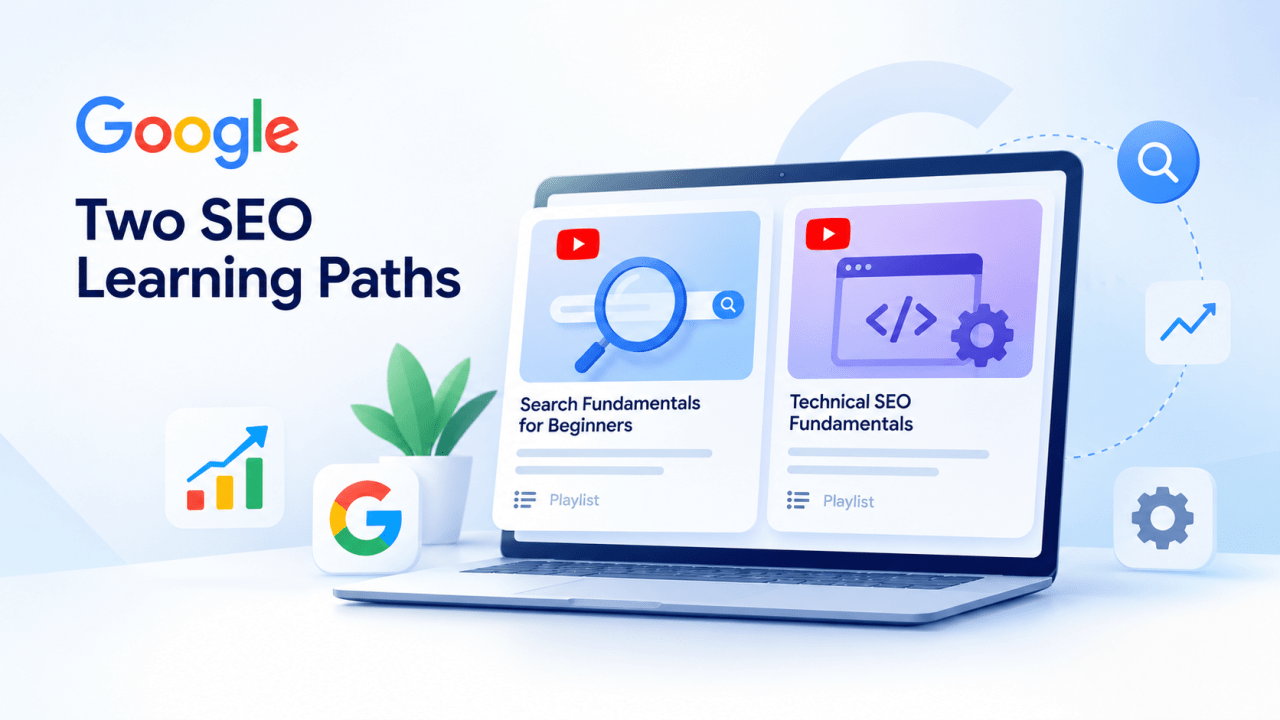
Google Introduces Two SEO Learning Paths: Search Fundamentals and Technical SEO Explained
RMRevx Media Oct 21, 2026 11 min read

Search engine optimization (SEO) involves more than choosing keywords and publishing content. To improve a website's visibility in Google Search, marketers and website owners need to understand how Google discovers pages, processes content, indexes information, and presents relevant results to users.
However, learning SEO can be challenging. Beginners often struggle to identify where to start, while experienced professionals need reliable resources to strengthen their technical knowledge and troubleshoot complex website issues.
To make learning more structured, Google Search Central has introduced two curated YouTube playlists: Search Fundamentals for Beginners and Technical SEO Fundamentals. These learning paths are designed for different experience levels, helping viewers build their knowledge of Google Search and understand the technical factors involved in website optimization.
In this article, we'll explore what these playlists cover, who should watch them, and how businesses and digital marketers can apply these lessons to their SEO strategies.
Google Search Central has organized educational videos from its YouTube channel into two dedicated learning paths. Instead of searching through individual videos across different series, viewers can follow a more structured collection of resources based on their needs.
The two playlists focus on different aspects of SEO:
Search Fundamentals for Beginners: Introduces the essential concepts of Google Search, search visibility, and performance measurement.
Technical SEO Fundamentals: Focuses on website infrastructure, crawling, indexing, rendering, and technical troubleshooting.
Both playlists are intended to help people learn directly from Google's educational resources.
You can explore the official playlists here:
For the complete announcement, visit Google Search Central.
The first playlist is designed for website owners, marketers, content creators, and people who are new to SEO. It covers the foundational concepts needed to understand how Google Search works and how to measure a website's performance.
Before a page can appear in Google Search results, Google generally needs to discover it, crawl it, and process its content for potential indexing.
These processes serve different purposes:
Crawling: Google discovers URLs and fetches their content.
Indexing: Google processes information about a page and may include it in its search index.
Serving search results: Google selects and displays relevant results in response to a user's query.
Understanding these stages helps website owners investigate why a page might not appear in search results. For example, a page could be difficult for Google to discover, inaccessible to crawling, or excluded from indexing.
Importantly, crawling and indexing do not guarantee that a page will rank prominently for a particular keyword.
Google Search Console is an essential tool for monitoring a website's organic search performance.
It helps website owners and SEO professionals understand how their pages perform in Google Search and identify potential technical or indexing issues.
Key areas to explore include:
Performance reports: Review clicks, impressions, click-through rates, and average position.
Indexing reports: Investigate which pages are indexed and identify reported indexing problems.
URL Inspection: Examine Google's information about a specific URL and investigate its indexing status.
Search Console Insights: Explore useful information about content performance and audience engagement in Search.
For example, if a page receives impressions but few clicks, reviewing its search queries, title, description, and search intent may help identify opportunities to improve its performance.
Creating content around relevant search demand is an important part of SEO. Google Trends helps marketers explore search interest over time, compare topics, and identify emerging trends.
Businesses can use it to:
Discover seasonal changes in interest.
Compare the popularity of related topics.
Identify topics worth researching further.
Plan content around relevant industry developments.
However, Google Trends shows relative search interest rather than absolute search volume. Its data should be combined with keyword research, audience insights, and business objectives before making content decisions.
Who should watch this playlist?
This learning path is particularly useful for SEO beginners, digital marketers, content writers, website owners, and business teams looking to understand organic search fundamentals.
The second playlist is aimed at developers and technical SEO specialists who need a deeper understanding of how website architecture and technical implementation affect Google Search.
Technical SEO is especially important for websites with large numbers of URLs, complex navigation, JavaScript-heavy interfaces, or ongoing indexing issues.
Search engines need to discover important pages and understand which URLs should be crawled.
Technical SEO involves reviewing elements such as:
Robots.txt: Provides instructions to compliant crawlers about which URL paths they may access.
XML sitemaps: Help search engines discover URLs that a website considers important.
Internal linking: Helps users and search engines navigate between related pages.
Crawl statistics: Provide information about Google's crawling activity on a website.
A well-organized website makes important content easier to discover. However, simply submitting a sitemap or optimizing crawl activity does not guarantee indexing or improved rankings.
Crawl budget optimization is generally more relevant to large or frequently updated websites than to small websites with relatively few pages.
Indexing issues can affect organic visibility when important pages are not included in Google's search index.
Common problems include accidental noindex directives, incorrect canonical URLs, duplicate content, inaccessible pages, and inconsistent internal linking.
Google Search Console's Page Indexing report and URL Inspection tool can help diagnose many of these issues.
For larger websites, technical SEO specialists may also need to analyze URL patterns, server responses, canonicalization rules, and page templates to identify recurring problems.
The goal is not to get every URL indexed. It is to help Google discover and process the pages that provide genuine value to users and support the website's objectives.
Modern websites often rely on JavaScript to display content or deliver interactive features. While Google can render JavaScript, rendering behavior and implementation issues can affect how page content is processed.
Technical teams should check whether important content, internal links, and metadata are available in a way Google can process.
Useful areas to investigate include:
Whether important page content is accessible after rendering.
Whether internal links use crawlable HTML links.
Whether essential content depends on interactions that crawlers may not perform.
Whether excessive page resources or technical errors interfere with page delivery.
Rendering should be tested rather than assumed to be a problem simply because a website uses JavaScript.
Duplicate or substantially similar URLs can complicate search engine understanding of a website's preferred pages.
For example, product filters, tracking parameters, sorting options, and alternative URL formats may create multiple URLs with similar content.
Canonical tags help indicate a preferred URL among duplicate or similar pages. Consistent internal linking and appropriate URL management can also support clearer site architecture.
Canonical tags are signals, not absolute commands. Google may select a different canonical URL when other signals indicate that another version is more appropriate.
Websites with substantial search traffic or large URL inventories may need more scalable ways to analyze search performance.
Search Console APIs and bulk data exports can help teams retrieve or analyze search performance information beyond what is convenient to review manually.
These approaches can support:
Automated reporting workflows.
Large-scale performance analysis.
Trend monitoring across pages and queries.
Integration with analytics and business reporting systems.
The appropriate approach depends on the size of the website, the volume of data, and the questions the team needs to answer.
Who should watch this playlist?
This learning path is best suited to technical SEO specialists, web developers, SEO managers, and teams responsible for maintaining complex websites or investigating persistent search visibility problems.
The right playlist depends on your current knowledge and responsibilities.
Your role or requirementRecommended playlistNew to SEOSearch Fundamentals for BeginnersContent writer or digital marketerSearch Fundamentals for BeginnersBusiness owner managing a websiteSearch Fundamentals for BeginnersSEO professional strengthening technical skillsTechnical SEO FundamentalsWeb developer troubleshooting indexing or renderingTechnical SEO FundamentalsTechnical SEO specialist working with large websitesTechnical SEO Fundamentals
If you're new to SEO, start with the fundamentals. Learning how Google Search works and how to interpret Search Console data will give you a stronger foundation before you tackle advanced technical issues.
If you already understand keyword research, organic performance reports, and basic SEO concepts, the technical playlist may be a better next step.
Experienced SEO professionals can also use both playlists to revisit foundational concepts and strengthen their understanding of Google's systems.
Watching educational videos is useful, but the real value comes from applying what you learn to an actual website.
Businesses can use these concepts to improve their SEO processes in several practical ways.
Check whether important service pages, product pages, and blog articles are eligible for indexing. Investigate unexpected exclusions and resolve technical issues that prevent valuable content from being discovered or processed.
Use Search Console to understand which queries generate impressions and clicks. Combine this information with keyword research, customer questions, and Google Trends to identify relevant content opportunities.
Prioritize topics that match your audience's needs and your business offerings instead of publishing articles simply because a keyword appears popular.
Review internal links, navigation, URL structures, and sitemap coverage. Make sure important pages are accessible through logical pathways and that unnecessary URL variations do not create avoidable complexity.
Track relevant metrics such as clicks, impressions, click-through rate, and conversions from organic search.
Rankings alone do not tell the full story. A website may attract more visitors without generating meaningful enquiries if the content, landing pages, or conversion journey do not match user intent.
SEO and paid advertising can support the same business objectives, but they work differently.
Google Ads can provide paid visibility for relevant searches, while SEO aims to build organic visibility over time. Search query data, landing-page performance, and conversion insights can inform decisions across both channels.
For example, a business can investigate which search terms generate qualified leads through paid campaigns and use those insights to guide further organic content research. Organic performance can also reveal topics and pages worth evaluating in a broader acquisition strategy.
Neither channel guarantees results. Both require relevant targeting, strong landing pages, reliable measurement, and ongoing optimization.
Need Help Improving Your Website's Search Visibility?
Understanding SEO is the first step. Turning that knowledge into better search visibility, qualified website traffic, and business growth requires the right strategy and execution.
RevX Media helps businesses strengthen their digital presence through SEO, Google Ads, and performance-driven digital marketing strategies.
Explore our services to discover how we can support your business growth.
SEO advice online can vary significantly in quality. Some recommendations are based on outdated practices, while others make claims about ranking factors without sufficient evidence.
Google Search Central provides first-party educational resources explaining how Google Search works and how website owners can approach search optimization.
Learning from these resources helps marketers distinguish between technical requirements, recommended practices, and assumptions about rankings.
However, Google's educational material should be treated as a foundation, not a substitute for practical experience. Every website has different technical constraints, audiences, competition, and business objectives.
The most effective approach is to learn the concepts, apply them to your website, measure the results, and investigate problems using reliable data.
Google's new Search Fundamentals for Beginners and Technical SEO Fundamentals playlists provide structured learning paths for people with different levels of SEO experience.
The first focuses on understanding Google Search, using Search Console, and researching content opportunities. The second explores technical areas such as crawling, indexing, rendering, duplicate content, and scalable data analysis.
For beginners, these resources offer a useful starting point. For experienced marketers and developers, they provide an opportunity to strengthen their knowledge and improve how they diagnose search-related issues.
Ready to strengthen your website's search visibility? Start with Google's official learning resources, assess your website's current performance, and prioritize improvements based on real data and business goals.
At RevX Media, our approach to digital marketing focuses on connecting search visibility, website performance, and measurable business outcomes. Explore the strategies and services most relevant to your growth objectives.
Ready to Grow Your Business Online?
From improving organic search visibility to running targeted paid campaigns, RevX Media helps businesses build a stronger digital presence with a results-focused marketing approach.
Explore RevX Media's digital marketing services and find the right strategy for your business.
Get a free, no-pressure growth audit. We will show you exactly where you are leaving revenue on the table.