Back to blog
Predictive Modeling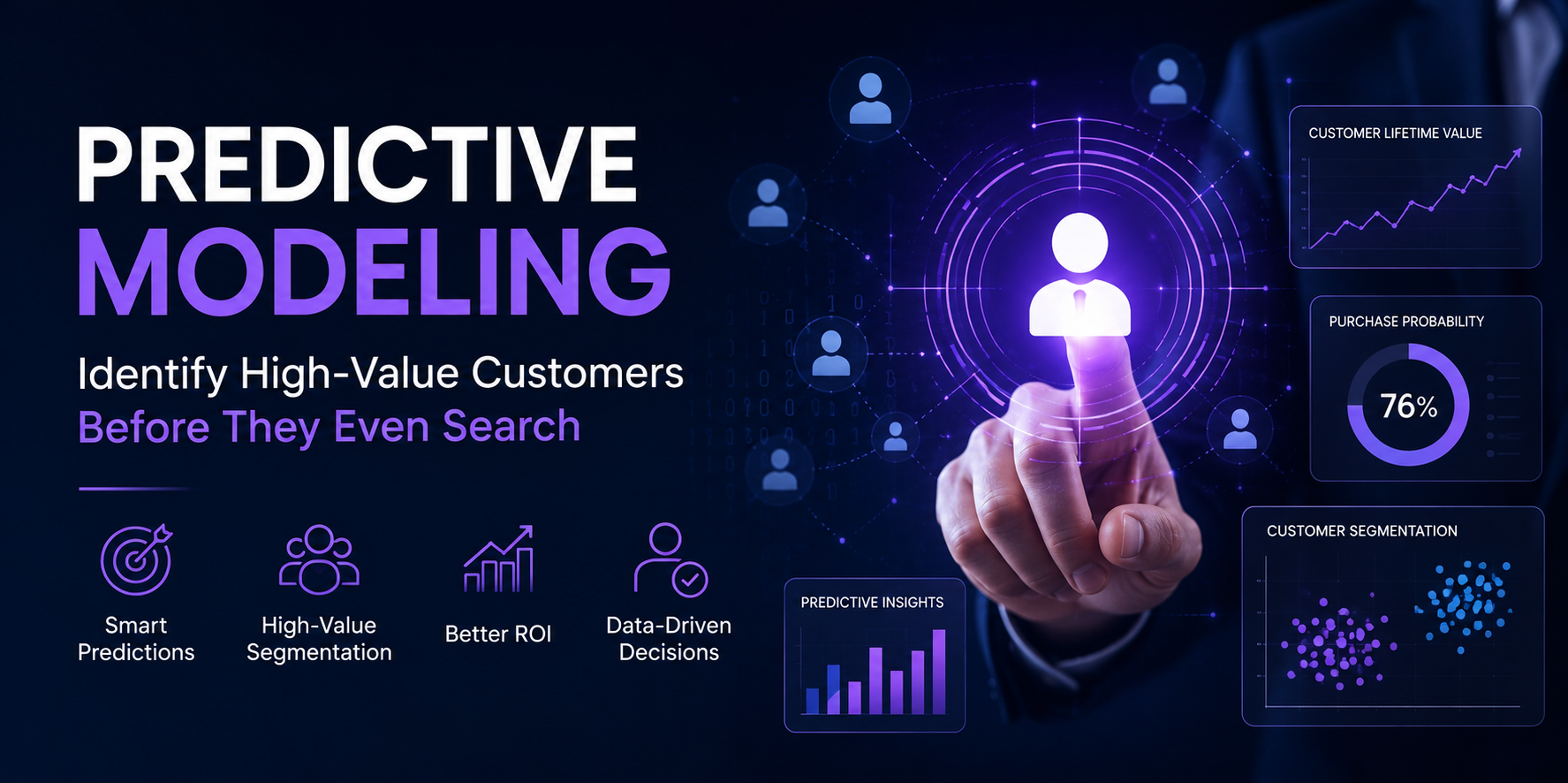
How to Use Predictive Modeling to Identify High-Value Customers Before They Even Search
IKIkshita Kashyap Sep 06, 2026 4 min read

Most businesses wait for customers to search, click an ad, fill out a form, or make a purchase before deciding how valuable they are.
By then, the opportunity to influence the customer journey has already started.
Predictive modeling changes this approach. Instead of waiting for a customer to convert, businesses can analyze historical customer and behavioral data to estimate who is more likely to become a high-value customer—and use those insights to make better marketing decisions earlier.
For performance-focused brands, this can mean better targeting, smarter budget allocation, and more efficient customer acquisition.
What Is Predictive Modeling in Marketing?
Predictive modeling uses historical and current data to identify patterns that can help estimate future customer behavior.
For example, two visitors may spend the same amount of time on a website. One may be more likely to purchase repeatedly, choose a higher-value product, or remain a customer longer.
A predictive model can look beyond the immediate conversion and estimate signals such as:
Purchase probability
Expected customer lifetime value
Likelihood of repeat purchases
Churn risk
Probability of becoming a qualified lead
The goal isn't to predict the future perfectly. It's to make marketing decisions using stronger signals than assumptions alone.
Why High-Value Customers Matter More Than Conversions
A conversion doesn't always equal a valuable customer.
Imagine two customers:
Customer A makes one ₹2,000 purchase and never returns.
Customer B makes a ₹5,000 purchase, returns several times, and generates ₹30,000 in revenue over the next year.
If your marketing team optimizes only for the first purchase, both customers may look successful.
But from a business perspective, Customer B is far more valuable.
This is where predictive analytics in marketing becomes useful. Instead of optimizing campaigns only around conversions, businesses can start identifying the characteristics and behaviors associated with long-term customer value.
What Data Can Predict a High-Value Customer?
The quality of a predictive model depends heavily on the data behind it.
Depending on your business, useful signals can include:
Previous purchases
Order frequency and average order value
Website behavior
Product or service pages viewed
Pricing-page visits
Content engagement
Email interactions
Ad engagement
CRM data
Lead source
Customer demographics
Time between first interaction and purchase
Repeat purchase behavior
For example, a visitor who repeatedly compares products, reads detailed guides, checks pricing, and returns several times may show stronger purchase intent than someone who visits once and leaves.
Individually, these actions may not mean much. Together, they can become useful predictive signals.
How Predictive Modeling Identifies High-Value Customers
A practical predictive marketing process usually follows a few important steps.
1. Define What “High-Value” Means
Start with the business outcome.
For an ecommerce brand, a high-value customer might be someone expected to generate ₹25,000+ in revenue over 12 months.
For a B2B company, it could be a lead with a high probability of becoming a large recurring account.
Without a clear definition of customer value, the model has nothing meaningful to predict.
2. Combine Customer and Behavioral Data
Bring relevant data together from your website analytics, CRM, advertising platforms, ecommerce system, and customer database.
This creates a more complete picture of the customer journey.
3. Identify Valuable Signals
Look for behaviors that historically appear more frequently among your best customers.
These could include higher engagement, repeat visits, specific product interactions, larger initial purchases, or particular acquisition sources.
4. Build Customer Value Predictions
The model assigns a probability, score, or predicted value to customers based on the patterns found in historical data.
For example:
Customer A: High probability of repeat purchase
Customer B: Low predicted lifetime value
Customer C: Strong probability of becoming a high-value customer
These scores can then become actionable marketing signals.
Using Predictive Modeling Before Customers Search
This is where predictive modeling becomes particularly powerful.
You don't necessarily have to wait until someone searches for your product to decide how aggressively you should market to them.
Predictive insights can help with:
Audience Segmentation
Create audiences based on predicted customer value rather than basic demographics or broad interests.
Budget Allocation
If certain audience groups consistently produce customers with higher lifetime value, you can prioritize them instead of distributing budgets equally.
Paid Media Optimization
Predictive signals can help performance marketing teams focus campaigns on users who are more likely to generate valuable outcomes—not simply cheap conversions.
Personalization
High-value customer predictions can inform offers, messaging, product recommendations, and remarketing strategies.
Retention
Predictive analytics can also identify customers who are likely to disengage, giving businesses an opportunity to act before they leave.
Get a free, no-pressure growth audit. We will show you exactly where you are leaving revenue on the table.